
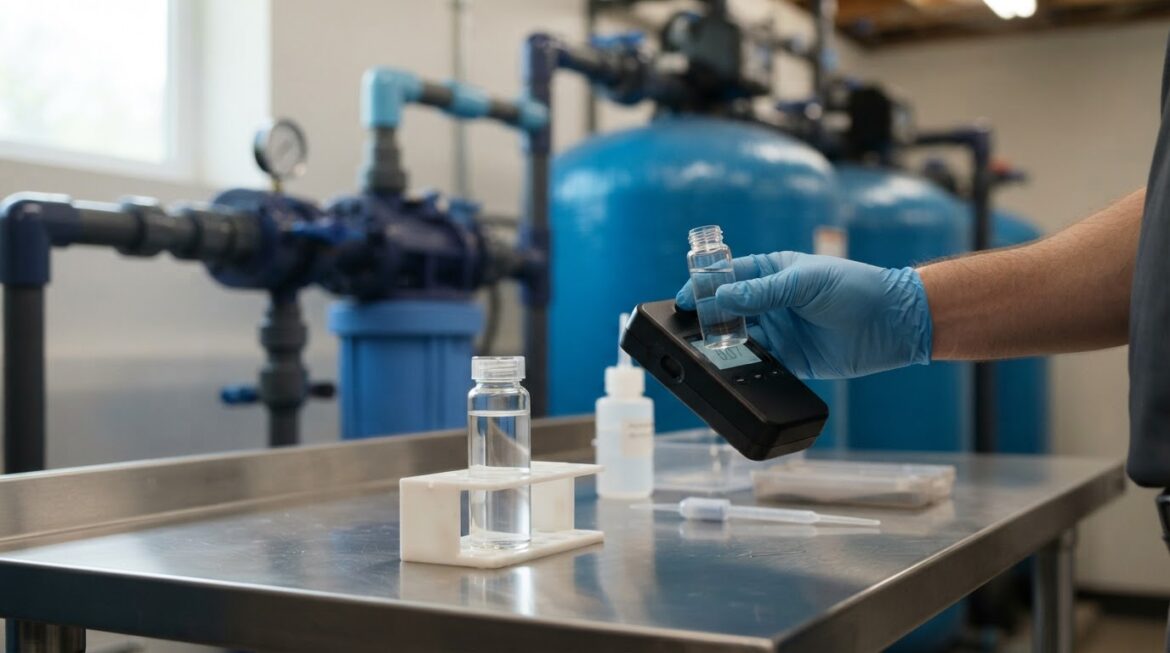
A homeowner installs a whole-house carbon filter, tests the water afterward, and discovers that the chlorine reading is still above zero. Does that mean the filter isn’t working? Not necessarily. Before interpreting the result, we need to know what the test actually measured.
Free chlorine, total chlorine, and combined chlorine are related but different measurements. Understanding the distinction is especially important when evaluating filtration systems designed to reduce chlorine or chloramine. At Pro Filtration Water Systems, we believe water treatment should begin with measurable conditions and clearly defined objectives—not assumptions about what a particular filter can accomplish.
What Is Free Chlorine?
Free chlorine refers to the portion of chlorine disinfectant available in water primarily as hypochlorous acid (HOCl) and hypochlorite ion (OCl⁻). Municipal water utilities use disinfectants to help control microorganisms as water moves through distribution systems. Free chlorine is one common form of disinfectant residual. A free-chlorine test measures this specific category of residual. It does not measure all chlorine-containing disinfectant compounds.
What Is Total Chlorine?
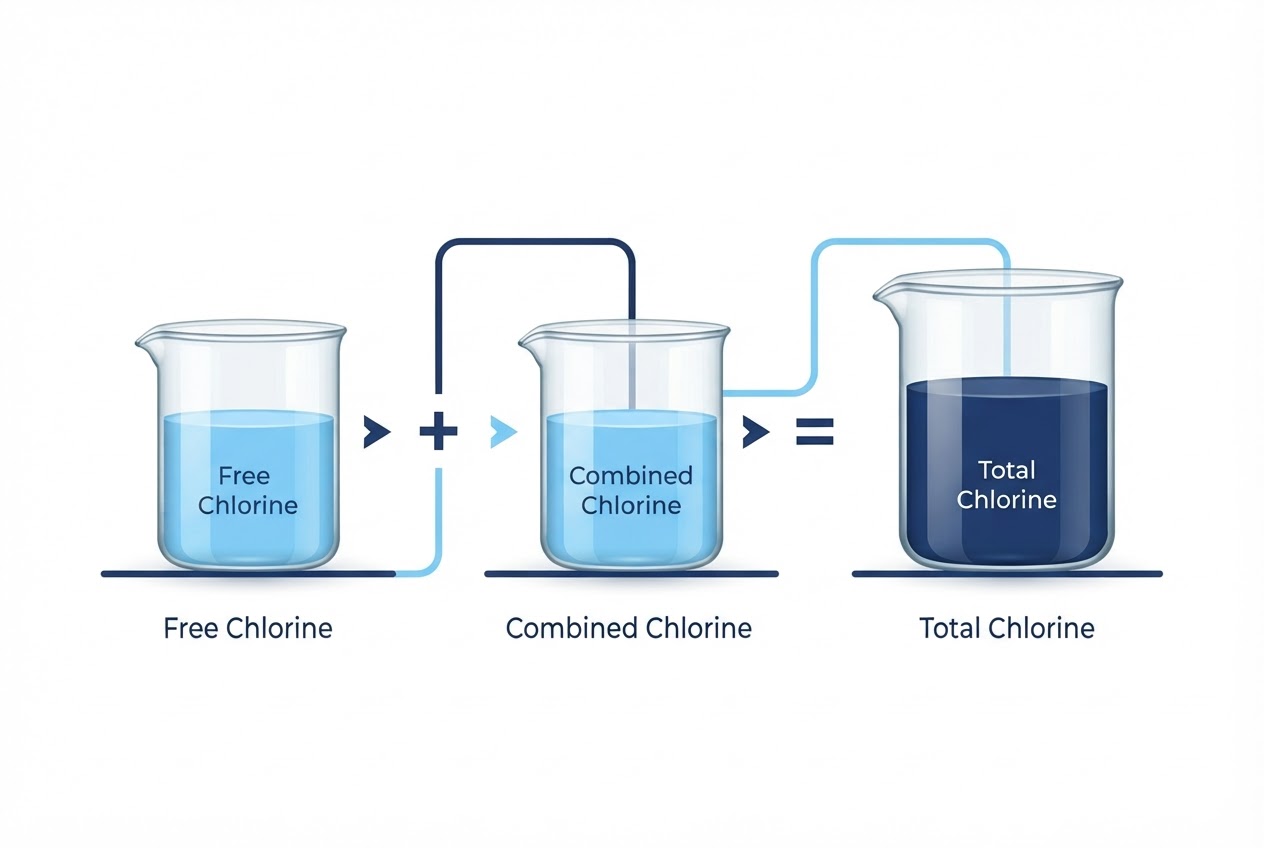
Total chlorine includes both free chlorine and combined chlorine. Total chlorine = Free chlorine + Combined chlorine. Combined chlorine includes chloramine species formed when chlorine reacts with ammonia or certain nitrogen-containing compounds. Municipal utilities commonly use monochloramine as a secondary disinfectant because it can provide a persistent residual through distribution systems.
How Do You Calculate Combined Chlorine?
When both measurements are reported in comparable units, combined chlorine can be estimated by subtracting free chlorine from total chlorine. For example, if free chlorine measures 0.2 mg/L and total chlorine measures 1.8 mg/L, the calculated combined chlorine is 1.6 mg/L. These values are hypothetical—not actual Orange County measurements.
Both tests should use representative samples and appropriate procedures. Small differences near a method’s reporting limit may reflect measurement uncertainty. Combined chlorine is not automatically identical to monochloramine concentration: subtraction estimates a category of residual, not the identity of every species present.
Why Can a Carbon Filter Show Zero Free Chlorine but Detectable Total Chlorine?
Water entering a filter may contain predominantly chloramine rather than free chlorine. A free-chlorine test might therefore show a low reading even before filtration. Testing only free chlorine after treatment could appear reassuring without establishing how much chloramine was reduced. Conversely, detectable total chlorine downstream may mean some residual remains; it does not by itself establish why or prove a filter is defective.
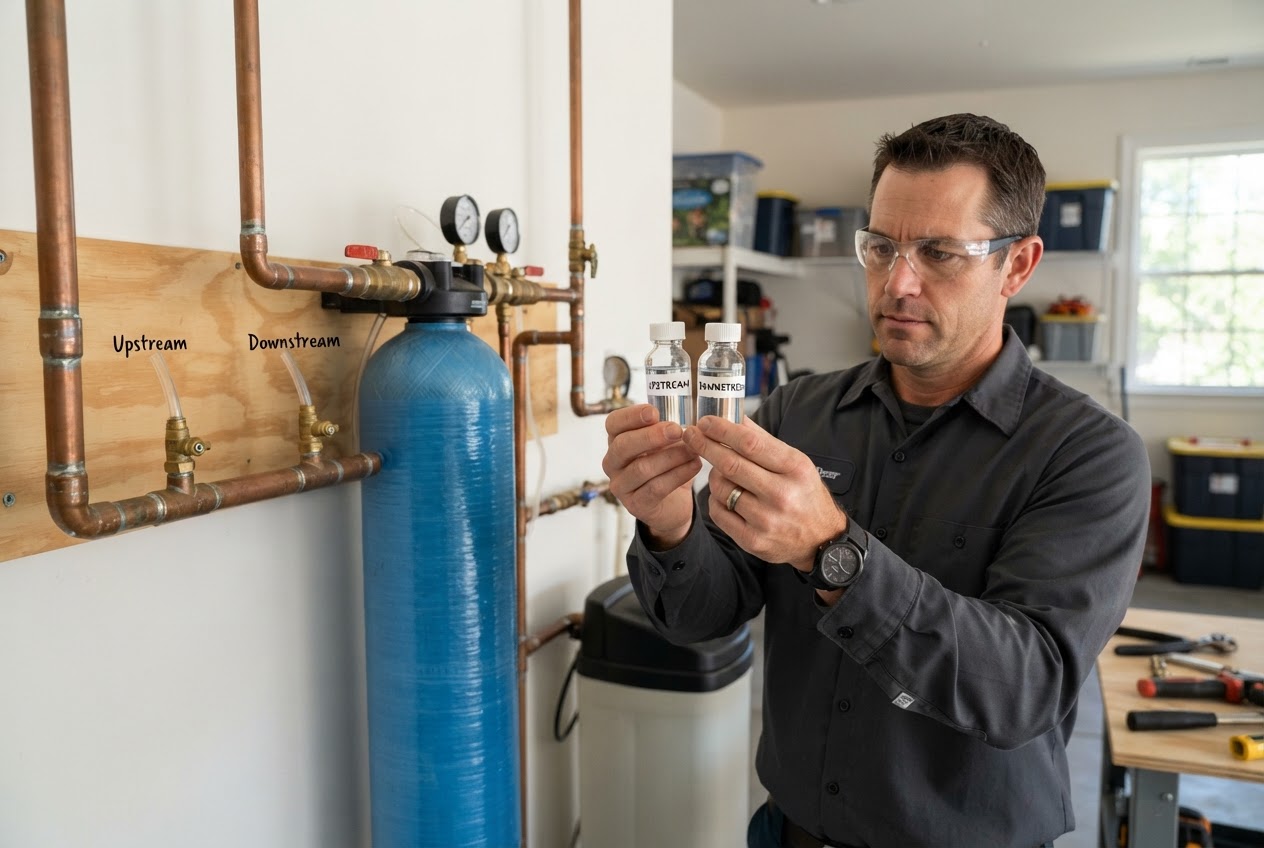
A meaningful comparison uses representative upstream and downstream samples under known operating conditions, including flow rate.
Why Catalytic Carbon Is Often Considered for Chloramine Reduction
Conventional activated carbon is widely used for reducing free chlorine and certain taste- and odor-causing compounds. Chloramine reduction can be more demanding. Certain catalytic-carbon media are designed to enhance reactions involved in reducing chloramine residuals. However, choosing catalytic carbon does not guarantee complete chloramine removal.
- Specific media performance data and bed configuration
- Media volume, water flow and contact time
- Incoming disinfectant concentration and water chemistry
- Media condition, accumulated treatment demand and maintenance
A carbon vessel can allow relatively high hydraulic flow while providing less disinfectant reduction at that flow than at a lower rate. The maximum hydraulic flow should not be confused with a verified treatment-performance flow. Learn more about whole-house water filtration.
How Should a Whole-House Carbon Filter Be Tested?
- Identify the treatment objective. Is the concern free chlorine, chloramine, taste and odor, or another constituent?
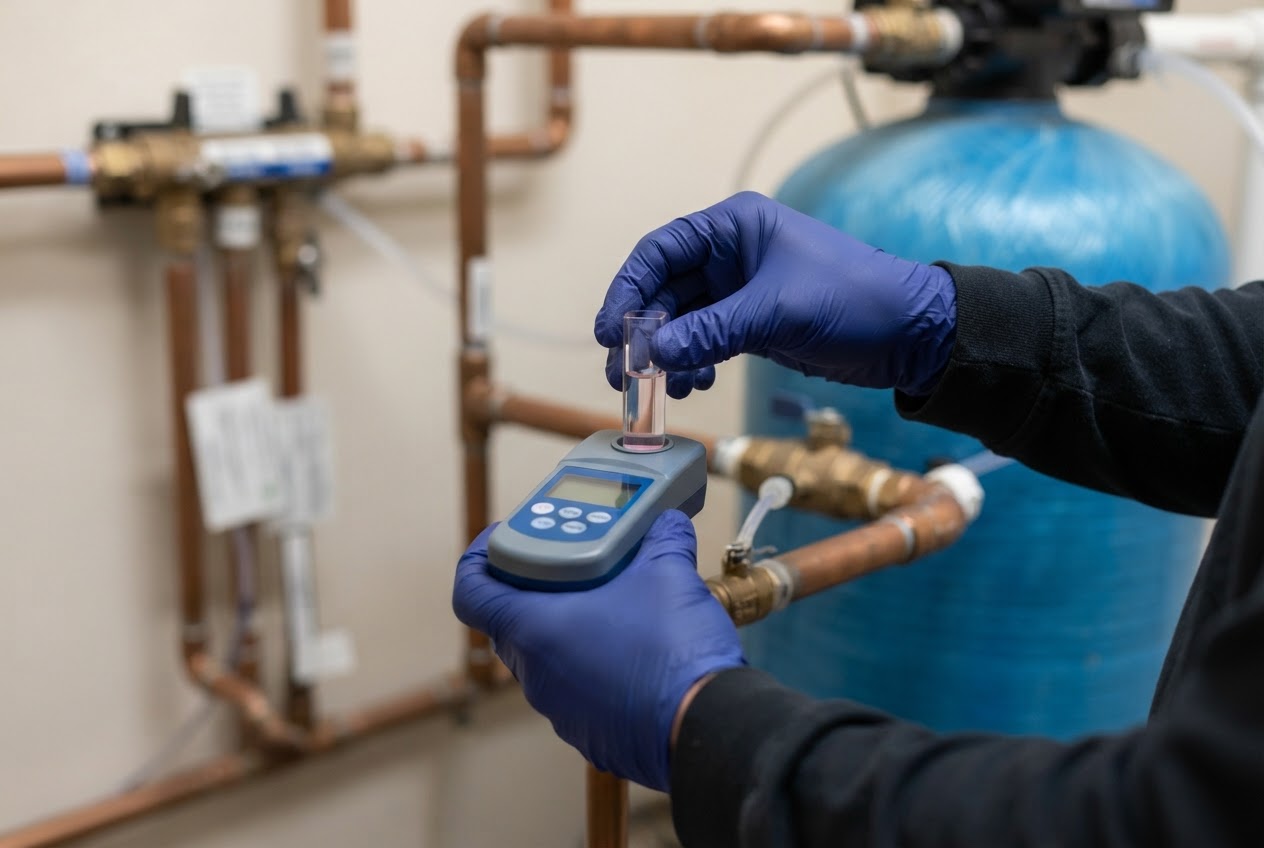
- Measure incoming water. Use suitable free- and total-chlorine methods on a representative upstream sample.
- Measure treated water. Sample downstream under appropriate operating conditions, not just from stagnant household piping.
- Record flow rate. A low-flow faucet test may not represent performance during simultaneous shower and appliance use.
- Follow test instructions. Observe reagent timing, sample handling, measurement ranges and potential interferences.
- Compare with the design objective. Determine whether treatment performance meets the specific, supportable target.
Can a Water Softener Remove Chlorine or Chloramine?
A conventional ion-exchange water softener primarily reduces hardness by exchanging calcium and magnesium ions for sodium or potassium ions. It is not a substitute for a properly designed disinfectant-reduction filter. Whole-house systems sometimes combine separate carbon filtration and water softening because these stages serve different purposes.
Does Removing Chlorine Make Water Safer?
Chlorine and chloramine are intentionally used in public drinking-water systems to help protect against microbial contamination. Reducing disinfectant residual may improve certain taste or odor characteristics, but should not automatically be presented as making already compliant municipal water safer or healthier. Reducing residual also changes conditions within downstream household plumbing, making appropriate maintenance and microbial considerations important. Specific health-related contaminant concerns call for appropriate testing and treatment certification.
Frequently Asked Questions
Is total chlorine always higher than free chlorine?
In principle, total chlorine includes free chlorine and should be equal to or greater than it. Small contrary differences in measurements can occur because of uncertainty, timing or interference.
Does zero free chlorine mean there is no chloramine?
No. Water may contain combined chlorine even when free chlorine is very low.
Can a chlorine test strip identify chloramine?
Not necessarily. It depends on what the strip measures and its sensitivity. A free-chlorine-only strip cannot establish total chlorine.
Is catalytic carbon always better than conventional activated carbon?
No. The right media depends on the target substance, water chemistry, flow and product performance specifications.
How often should a whole-house carbon system be tested?
There is no universal interval. Establish a baseline after commissioning, follow manufacturer guidance, and retest if performance changes or breakthrough is suspected.
Can total-chlorine testing prove my water is safe?
No. Disinfectant residual is only one aspect of water quality; the test does not establish compliance for every chemical or microbial contaminant.
A Better Approach to Water Treatment Design
At Pro Filtration Water Systems, we design customized residential water-treatment systems based on water-quality testing, plumbing conditions, household demand and maintenance requirements. Whether your goal is chlorine reduction, chloramine reduction, hardness control or drinking-water treatment, contact our team to discuss the right approach for your Orange County home.
Leave a Reply