
Whole House Water Softener Systems in Orange County
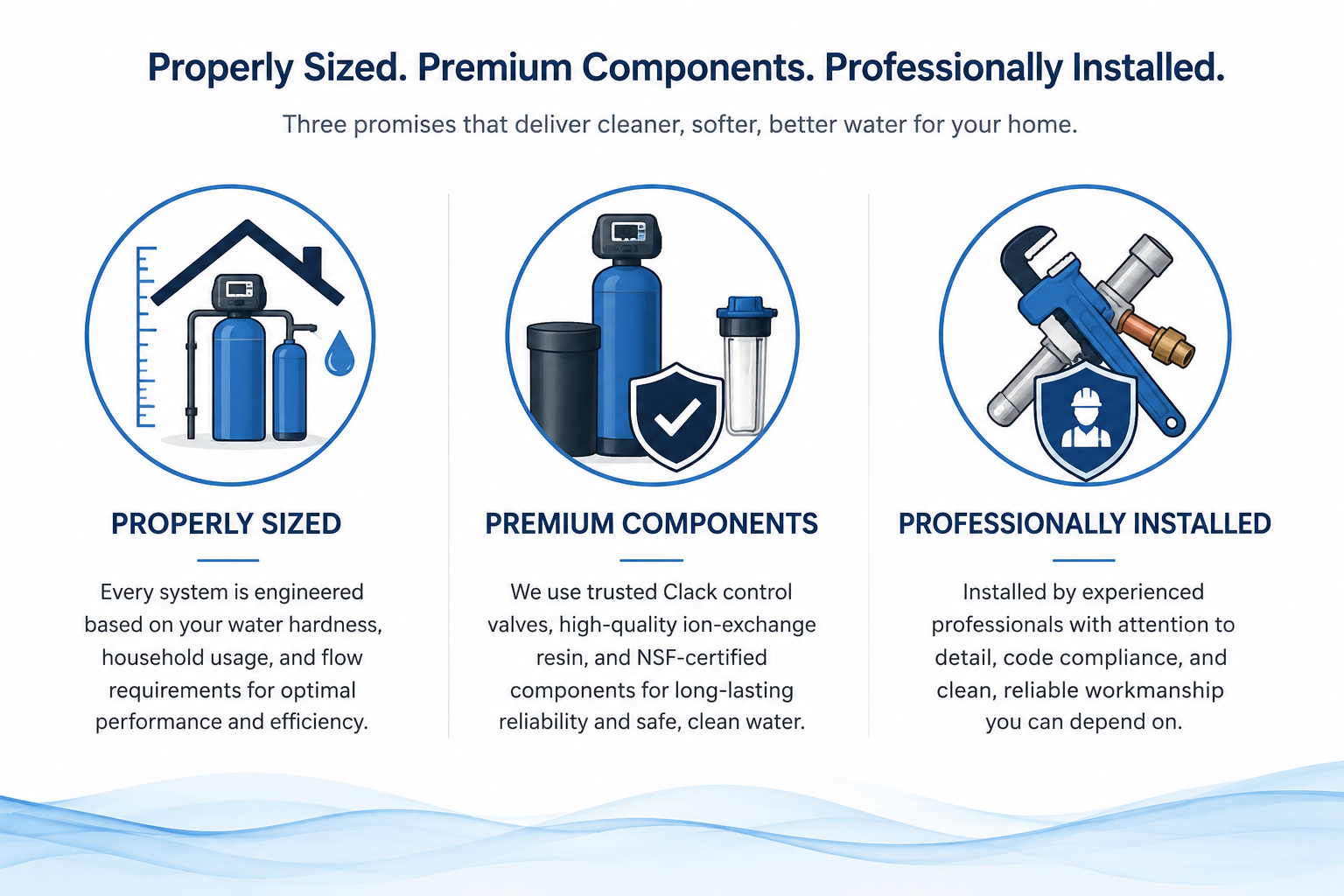
Professional water softener systems designed around your home’s actual water hardness, water usage, and flow requirements. Pro Filtration uses premium components, including Clack control valves and high-quality ion-exchange resin, to provide efficient hardness removal, reliable operation, and long-term performance.
What Is Hard Water?
Hard water contains naturally occurring dissolved minerals, primarily calcium and magnesium. As water moves through soil and rock, it picks up these minerals before reaching your home.
While hard water is generally not considered a health concern, high mineral levels can create problems throughout the home. When water is heated or evaporates, calcium and magnesium can leave behind scale deposits on plumbing fixtures, inside water heaters, and on other water-using appliances.
Water hardness is commonly measured in grains per gallon (GPG). The higher the hardness level, the greater the potential for scale buildup and reduced soap efficiency.
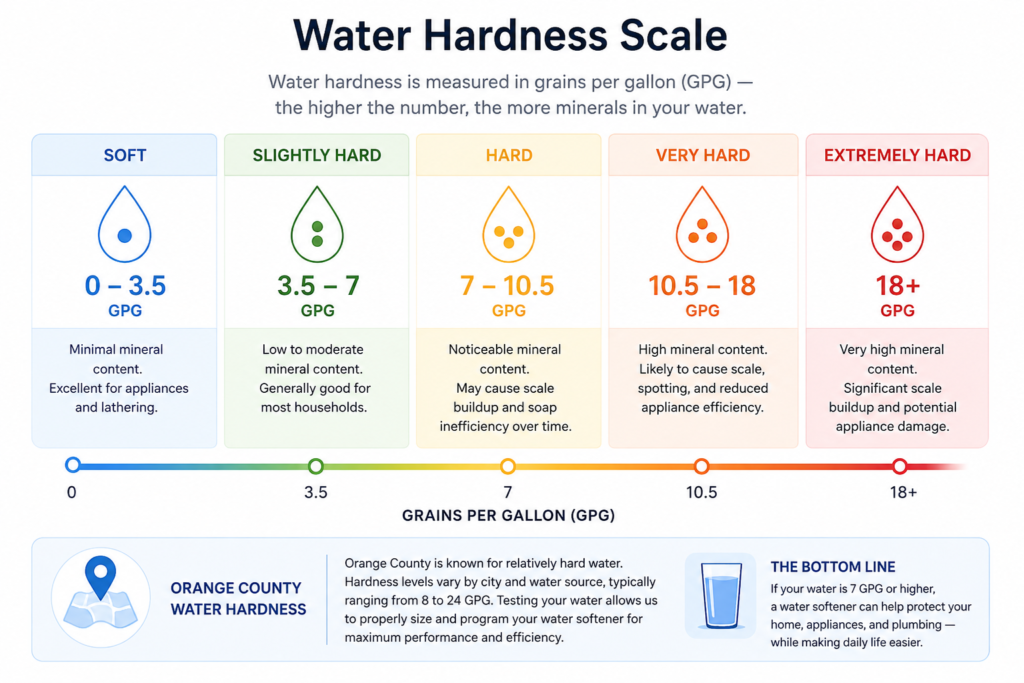
Orange County is known for relatively hard water, although hardness varies by city and water source. Testing the water at the property allows the softener to be sized and programmed based on actual conditions rather than assumptions.
How Hard Is the Water in Orange County?
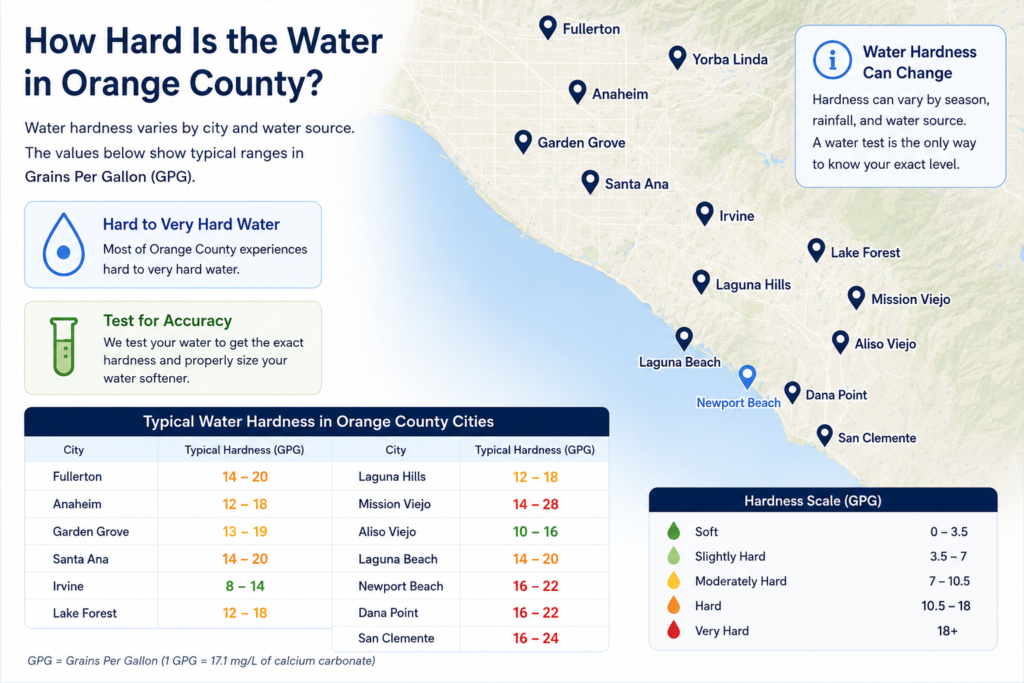
Orange County generally has hard to very hard water, although the exact hardness varies by city, neighborhood, season, and water source. Local water supplies may include both imported water and groundwater, so hardness levels can change over time.
For this reason, we don’t size a water softener based on location alone. Pro Filtration tests the actual water hardness at your property and uses the results together with household water demand and flow requirements to determine the appropriate system capacity and settings.
Water hardness directly affects how a softener should be sized and programmed. Higher hardness requires greater ion-exchange capacity to maintain efficient operation between regeneration cycles.er the potential for scale buildup and reduced soap efficiency.
The city gives us a starting point. Your water test gives us the number we design around.
What Are the Signs of Hard Water?
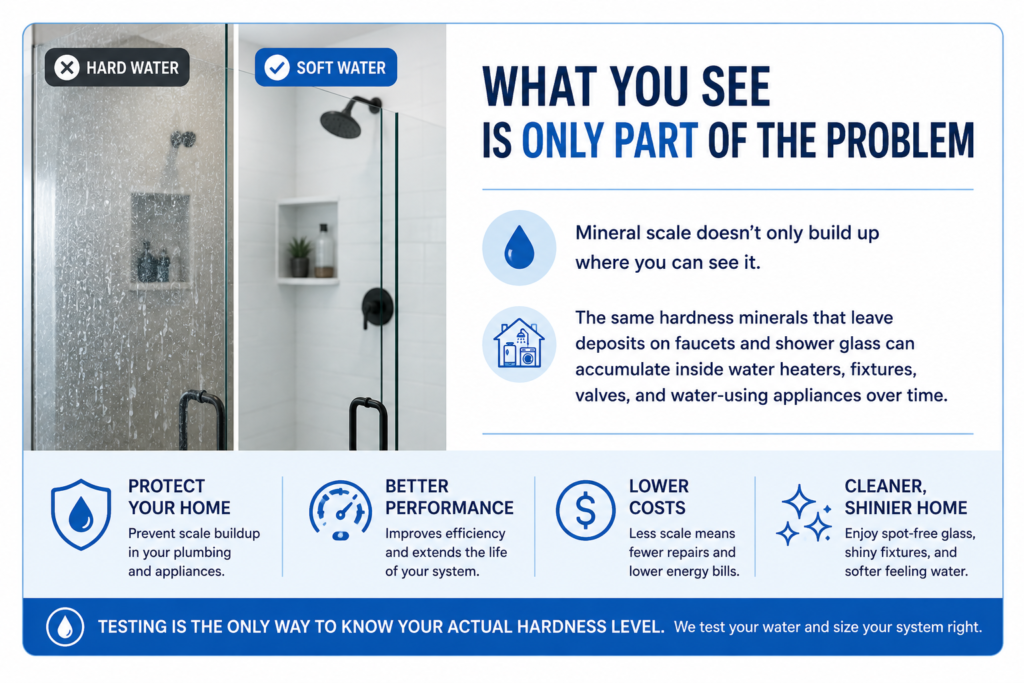
Hard water can affect everything from plumbing fixtures and shower glass to water heaters and household appliances. The minerals themselves are dissolved in the water, but as water evaporates or is heated, calcium and magnesium can leave behind visible scale and mineral deposits.
Common signs of hard water include:
- White scale on faucets and showerheads — mineral deposits often collect around aerators, valves, and other wet surfaces.
- Spots on glass and dishes — water evaporates and leaves dissolved minerals behind.
- Cloudy shower glass — repeated exposure can create stubborn mineral buildup that becomes difficult to remove.
- Reduced soap and shampoo lather — hardness minerals react with soap, requiring more product to achieve the same cleaning effect.
- Soap residue on sinks and showers — hard water can contribute to soap scum and make surfaces more difficult to keep clean.
- Scale inside water heaters and appliances — mineral deposits can accumulate on heating surfaces and internal components over time.
- Scale buildup in plumbing fixtures — deposits can gradually restrict small passages in aerators, showerheads, valves, and other components.
How Does a Water Softener Work?
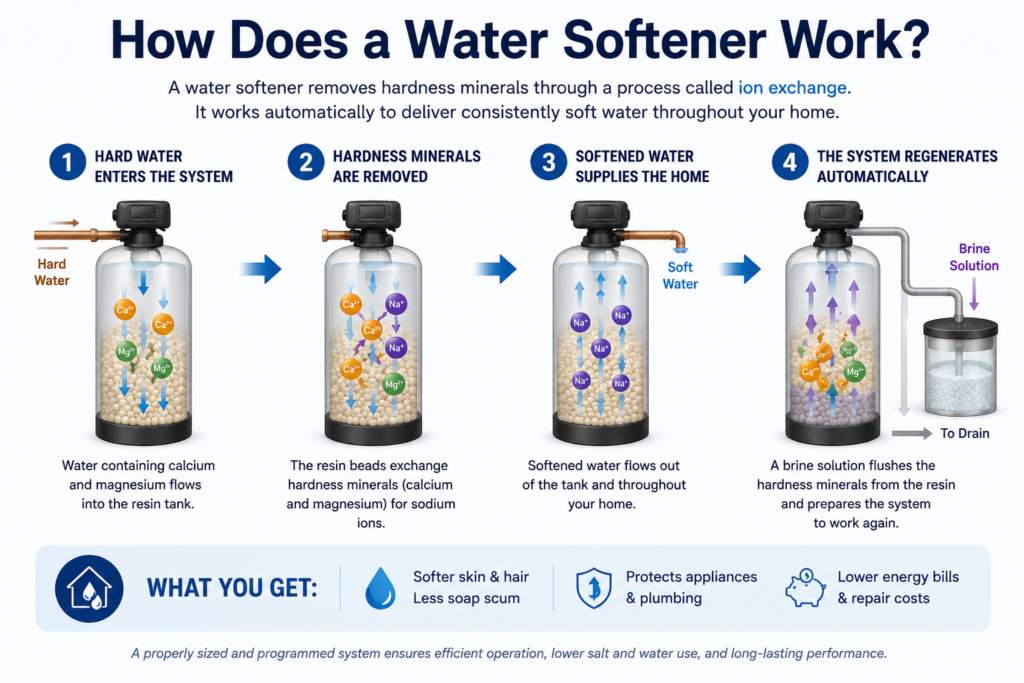
A water softener removes hardness minerals through a process called ion exchange. Inside the mineral tank are thousands of tiny resin beads that attract and hold calcium and magnesium—the primary minerals responsible for hard water.
As hard water flows through the resin bed, calcium and magnesium ions are exchanged for sodium ions. The hardness minerals remain attached to the resin while softened water continues through the plumbing system and into the home.
The Water Softening Process
- Hard Water Enters the System
Water containing dissolved calcium and magnesium enters the mineral tank and flows through the ion-exchange resin. - Hardness Minerals Are Removed
The resin captures calcium and magnesium ions and exchanges them for sodium ions, reducing the hardness of the water before it enters the home. - Softened Water Supplies the Home
Treated water leaves the mineral tank and flows to faucets, showers, water heaters, and other water-using appliances. - The System Regenerates Automatically
Eventually, the resin reaches its working capacity and must be regenerated. The control valve automatically draws a concentrated brine solution through the resin bed, releasing the accumulated calcium and magnesium and sending them to the drain.
After regeneration, the resin is ready to soften water again.
Modern water softeners don’t need to regenerate every night.
Built Around Reliable Clack Controls
The ion-exchange process is managed automatically by the system’s control valve. Pro Filtration uses Clack control valves for precise metering, regeneration control, and dependable long-term operation.
A properly programmed Clack valve monitors water usage and initiates regeneration based on the system’s actual capacity and demand—helping reduce unnecessary salt and water consumption.
How Is a Water Softener Properly Sized?
Water softeners should not be selected by tank size or advertised grain capacity alone. Proper sizing is based on the actual hardness of the water, household water demand, required flow rate, and the usable capacity of the resin.
At Pro Filtration, we use these factors to configure each system for efficient regeneration and consistent soft water without unnecessarily oversizing the equipment.
The Four Factors That Matter
- Water Hardness
Hardness is measured in grains per gallon (GPG). The higher the hardness, the more capacity the softener uses for every gallon of water treated. - Household Water Usage
The number of occupants and typical water consumption help determine how much softening capacity the home requires between regeneration cycles. - Peak Flow Rate
A softener must be able to handle periods when multiple fixtures are operating at the same time. Proper flow-rate sizing helps maintain water pressure while providing effective hardness removal. - Usable Resin Capacity
A system’s advertised maximum grain capacity doesn’t necessarily represent its most efficient operating capacity. Resin volume, salt dosage, and programming all affect how much usable capacity the system actually provides.
Bigger Isn’t Always Better
A larger softener is not automatically a better softener.
An undersized system may regenerate too frequently and struggle with higher water demand. An unnecessarily oversized system can go too long between regenerations and adds equipment capacity the home may never need.
The goal is to select the right resin volume, flow capability, and regeneration settings for the property.
Small Example: 18 GPG hardness × 300 gallons/day = 5,400 grains/day. This means the household uses approximately 5,400 grains of softening capacity per day. We can then use actual resin capacity and regeneration settings to configure the system appropriately.
Sizing determines the equipment. Programming determines how efficiently it operates.
Once the correct system size is established, the Clack control valve can be programmed around the home’s actual hardness, capacity, and water demand rather than relying on generic factory settings.
Premium Components Built for Long-Term Reliability
A properly sized water softener is only as reliable as the components inside it. Pro Filtration builds systems using professional-grade, serviceable components from established water-treatment manufacturers rather than proprietary equipment that can limit future service options.
Clack WS1 Control Valve
The control valve is the brain of the water softener. We use Clack WS1 control valves, known throughout the water-treatment industry for reliable operation, accurate metering, and straightforward servicing.
The valve measures actual water usage and controls each regeneration cycle based on the system’s programmed capacity and hardness settings.
Why we use Clack:
- Demand-based metered regeneration
- Precise programming
- Proven mechanical design
- Replaceable and serviceable components
- Widely supported in the water-treatment industry
Premium Ion-Exchange Resin
The resin is the material that actually removes calcium and magnesium from the water.
We use high-quality ion-exchange resin selected for residential water-softening applications. Resin quality, volume, water chemistry, and operating conditions all influence system capacity and service life.
For applications where additional chemical resistance is beneficial, 10% cross-linked resin can provide greater resistance to oxidation than standard 8% resin.
NSF-Certified System Components
Materials that come into contact with drinking water matter. We select tanks and system components from established manufacturers and use NSF-certified components where applicable for potable-water applications.
Our systems are built around recognizable, serviceable water-treatment components. Replacement parts and service are not dependent on a proprietary dealer-only platform.
Professional Water Softener Installation
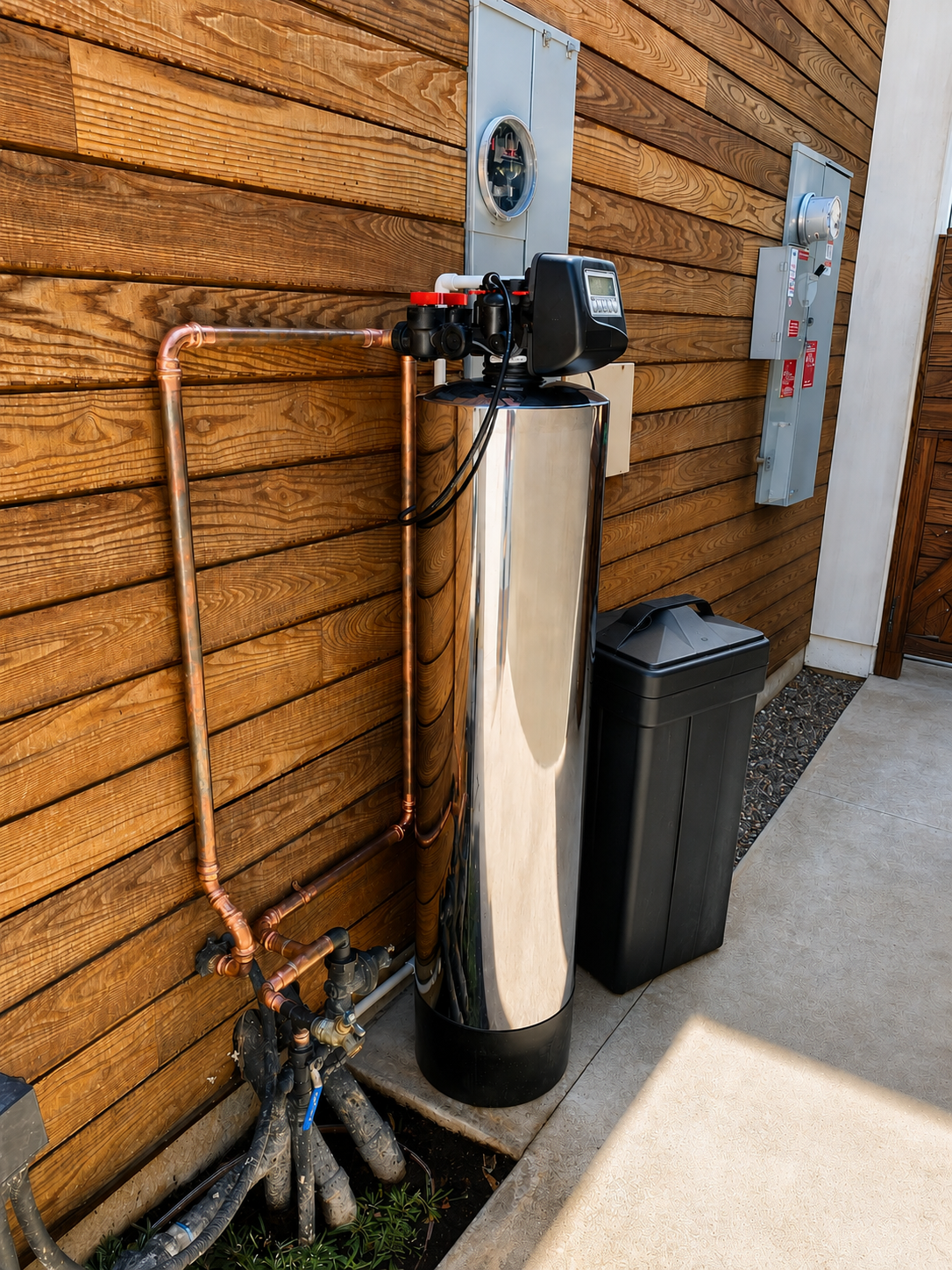
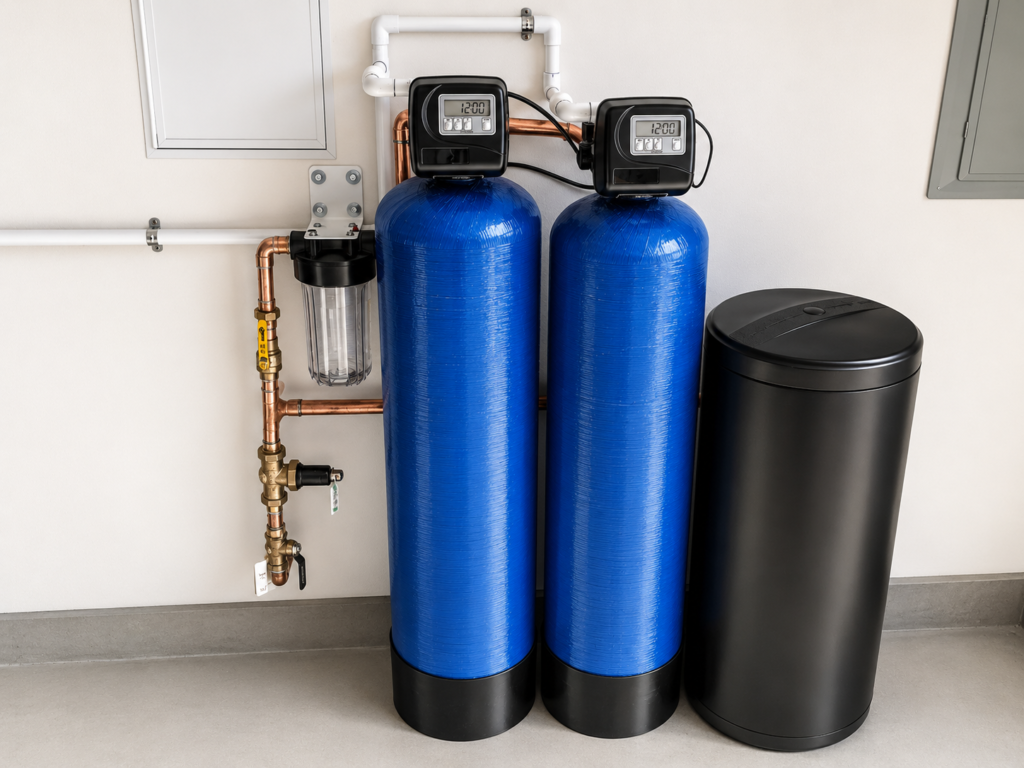
Even a properly sized water softener with premium components depends on correct installation. Proper plumbing layout, drain configuration, bypass placement, startup, and programming all contribute to reliable operation and long-term performance.
Pro Filtration installs each system around the home’s existing plumbing, available space, water pressure, and service requirements
What Proper Installation Includes
- Correct Plumbing Configuration
The system is integrated into the main water supply with proper flow direction, isolation, and bypass capability. - Proper Drain & Regeneration Setup
The regeneration drain is installed and configured to allow the system to regenerate correctly and reliably. - System Programming
The control valve is programmed using the home’s actual water hardness, resin capacity, and operating requirements rather than generic factory settings. - Startup & Testing
After installation, the system is placed into service, checked for proper operation, and tested before completion.
Installation isn’t just connecting two pipes.
Sizing, plumbing configuration, programming, and startup all determine how the system will perform after the installer leaves.
Water Softener vs. Salt-Free Water Conditioner: What’s the Difference?
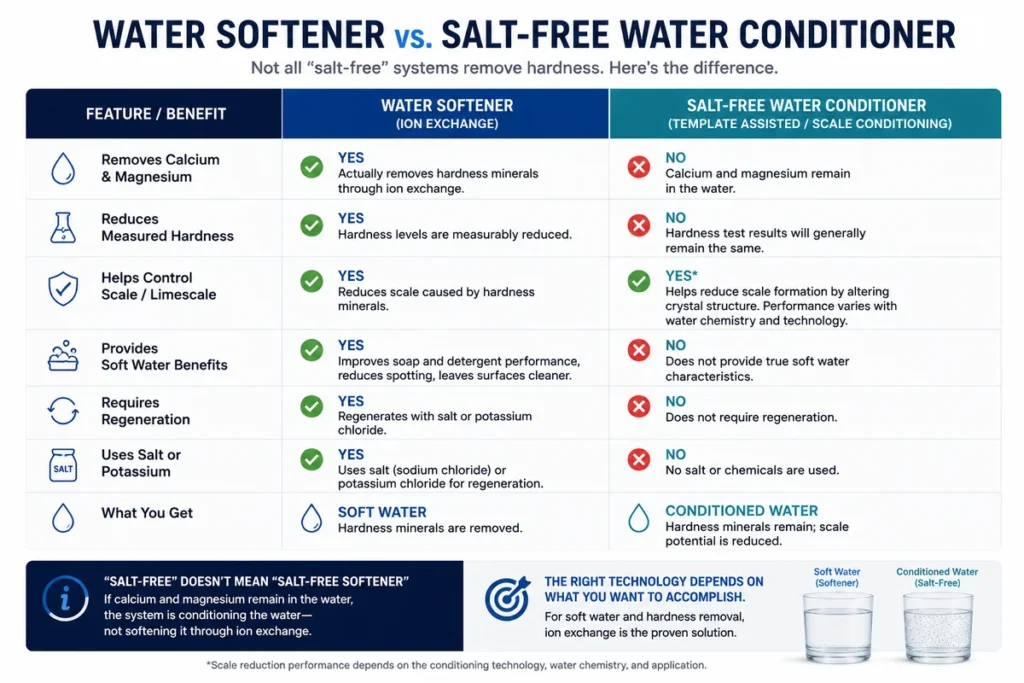
A traditional water softener and a salt-free water conditioner are not the same type of treatment.
A water softener uses ion exchange to remove hardness minerals such as calcium and magnesium from the water. Salt-free conditioning systems generally do not remove these minerals. Instead, they are designed to alter or manage how hardness minerals behave to help reduce their tendency to form scale.
Water Softener
Actually removes hardness minerals from the water.
- Removes calcium and magnesium through ion exchange
- Produces measurably softened water
- Reduces hardness scale
- Improves soap and detergent performance
- Requires periodic regeneration
- Uses salt or potassium chloride for regeneration
Salt-Free Conditioner
Conditions hardness minerals rather than removing them.
- Calcium and magnesium generally remain in the water
- Does not produce truly softened water
- May help reduce scale formation depending on technology and water chemistry
- Does not require salt regeneration
- Does not create the same soft-water characteristics as ion exchange
- Hardness testing before and after treatment will generally still detect hardness minerals
“Salt-Free” Doesn’t Mean “Salt-Free Softener”
If calcium and magnesium remain in the water, the system is conditioning the water—not softening it through ion exchange. The right technology depends on what you actually want to accomplish.
Not every water-quality problem is caused by hardness.
A water softener addresses calcium and magnesium, but chlorine, taste, odor, sediment, and other water-quality concerns require different treatment technologies.
Water Softener vs. Whole-House Water Filtration
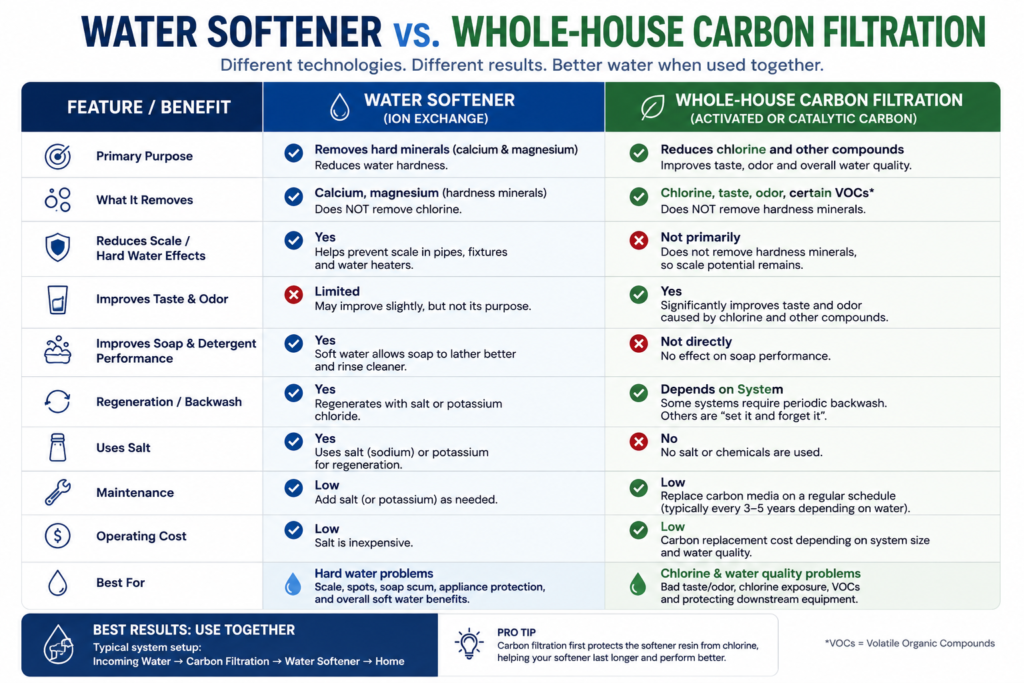
Water softeners and whole-house filtration systems perform different functions. A water softener removes hardness minerals, while a whole-house filtration system targets other water-quality concerns, depending on the filtration media and system design.
For many Orange County homes, the two technologies can be combined to provide more complete water treatment.
What Does a Water Softener Remove?
A water softener primarily addresses calcium and magnesium, the minerals responsible for water hardness.
It helps:
- Reduce scale buildup
- Protect plumbing fixtures and water heaters
- Improve soap and detergent performance
- Reduce spotting caused by hardness
- Provide the characteristics of softened water
What Does Whole-House Carbon Filtration Do?
A properly designed activated or catalytic carbon system is used primarily to reduce chlorine and certain other compounds that affect water quality, taste, and odor.
Depending on the carbon media and system design, filtration can help:
- Reduce chlorine
- Improve taste and odor
- Reduce certain organic compounds
- Protect downstream treatment equipment
- Improve water quality throughout the home
Why Combine Filtration and Softening?
For homes with both hard and chlorinated municipal water, combining carbon filtration with water softening addresses two separate issues.
A typical configuration is:
Incoming Water → Carbon Filtration → Water Softener → Home
The carbon system treats chlorine and related water-quality concerns first. The softener then removes calcium and magnesium before the treated water is distributed throughout the home.
Filtration Does Not Automatically Mean Softening.
A carbon filter can improve chlorine, taste, and odor while leaving the water just as hard as it was before treatment.
Filtration treats water quality. Softening treats hardness. A properly designed system can do both.
Want to learn more about chlorine and whole-house treatment?
Explore Whole-House Water Filtration →
How We Design Your Water Softener System
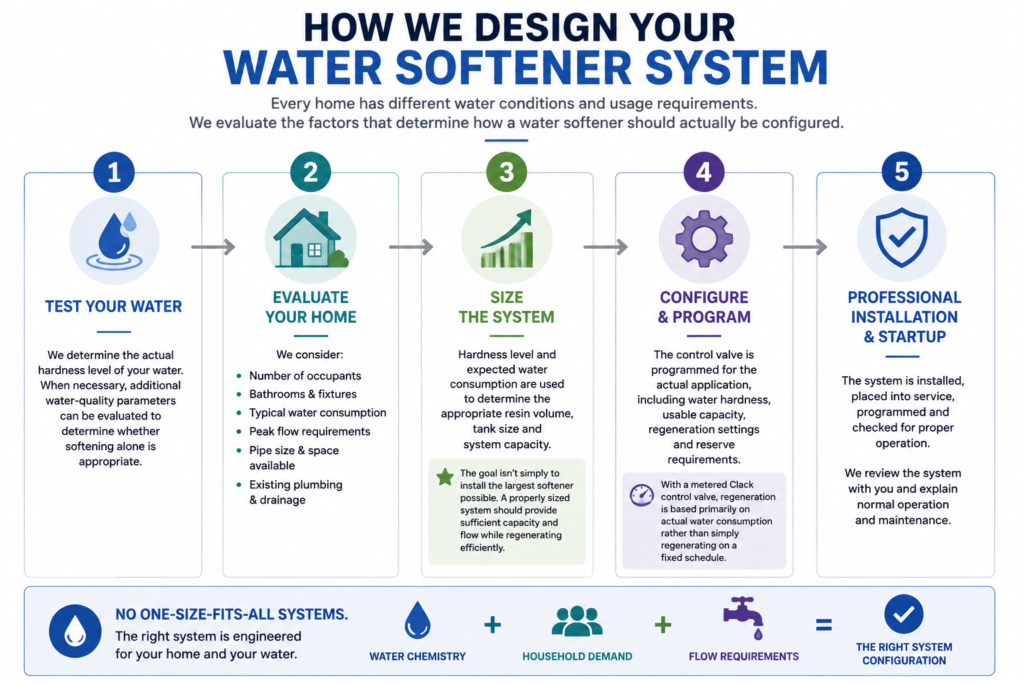
Every home has different water conditions and usage requirements. Instead of starting with a predetermined system size, we evaluate the factors that determine how a water softener should actually be configured.
1. Test Your Water
We determine the actual hardness level of your water. When necessary, additional water-quality parameters can be evaluated to determine whether softening alone is appropriate.
2. Evaluate Your Home
We consider:
- Number of occupants
- Bathrooms and plumbing fixtures
- Typical water consumption
- Peak flow requirements
- Pipe size and available installation space
- Existing plumbing and drainage
3. Size the System
Hardness level and expected water consumption are used to determine the appropriate resin volume, tank size and system capacity.
The goal isn’t simply to install the largest softener possible. A properly sized system should provide sufficient capacity and flow while regenerating efficiently.
4. Configure & Program
The control valve is programmed for the actual application, including water hardness, usable capacity, regeneration settings and reserve requirements.
With a metered Clack control valve, regeneration is based primarily on actual water consumption rather than simply regenerating on a fixed schedule.
5. Professional Installation & Startup
The system is installed, placed into service, programmed and checked for proper operation. We review the system with the homeowner and explain normal operation and maintenance.
Water Softener Installation Across Orange County
Pro Filtration designs and installs whole-house water softener systems throughout Orange County. Because water hardness varies by city and water source, each system is sized using the home’s actual water conditions and requirements.
📍 Irvine
📍 Mission Viejo
📍 Lake Forest
📍Newport Beach
📍 Laguna Niguel
📍 San Clemente
📍 Dana Point
📍 Rancho Santa Margarita
📍 Tustin