There is no single replacement schedule for every RO system
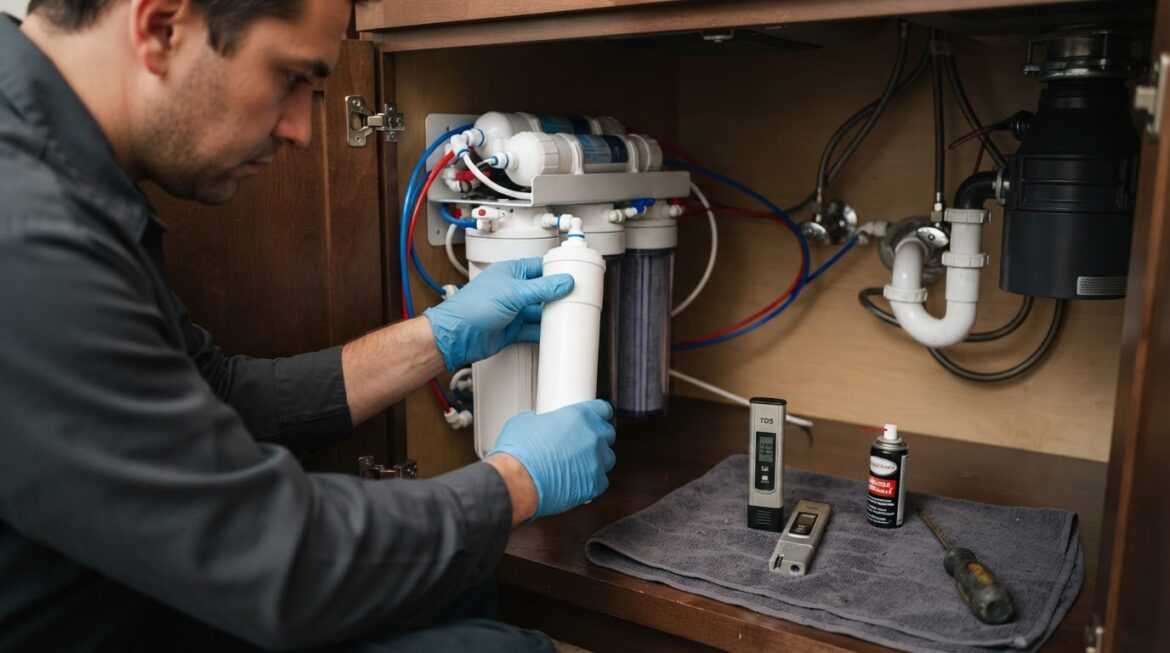
Reverse osmosis (RO) systems use several components with different jobs. Their service life depends on the manufacturer’s instructions, incoming water, household consumption and operating conditions. A calendar is useful for reminders, but testing and inspection help determine whether the system is still performing as intended.
Know which component you are replacing
Sediment prefilter: Helps capture particles that could foul downstream components. Replace according to the manufacturer’s schedule or sooner when loading causes significant flow restriction.
Carbon prefilter: Helps reduce disinfectants that can damage many thin-film composite RO membranes. The correct replacement interval depends on water quality, carbon capacity and use.
RO membrane: Separates much of the dissolved material in the feedwater. Its useful life varies considerably; declining rejection or production can indicate a problem.
Post-carbon filter: Typically polishes water after storage and should be replaced on its specified schedule.
Remineralization cartridge: Optional; follow its own maintenance instructions and account for its effect on the final TDS reading.
What TDS testing can—and cannot—tell you
A total dissolved solids (TDS) meter estimates the concentration of dissolved ions from electrical conductivity. Comparing feedwater and RO permeate can help track membrane performance. It does not identify individual contaminants, measure microbial safety or prove that drinking water is safe. Some substances are not reliably evaluated by a basic TDS meter.
How to calculate apparent membrane rejection
Use the same units for both readings: Rejection (%) = (1 − RO permeate TDS ÷ feedwater TDS) × 100. For example, 400 ppm feedwater and 20 ppm permeate gives 95% apparent rejection. Take the permeate reading before a remineralization stage, if installed, and follow the manufacturer’s test procedure. Temperature, pressure, water recovery and sample conditions can affect the result.
Signs your RO system needs attention
Watch for a sustained change in taste or odor, unusually slow production, a storage tank that no longer delivers its normal volume, leaks, persistent drain flow, or a significant change in membrane rejection. These symptoms do not all point to a bad membrane. A low-pressure supply, faulty tank air charge, clogged prefilter, malfunctioning automatic shutoff or restricted line can produce similar complaints.
Why upstream water treatment matters
Hardness can contribute to membrane scaling under certain operating conditions. Disinfectant breakthrough can damage susceptible membranes. A properly designed water softener or whole-house filtration stage may help address a specific feedwater issue, but neither replaces the RO system’s required prefilters and maintenance.
When should the whole RO system be replaced?
Consider replacement when the equipment is physically deteriorated, replacement parts are unavailable, the system cannot be serviced hygienically, or repeated repairs are no longer economical. Otherwise, replacing the correct filters or a worn membrane may be sufficient. A technician should check pressure, tank condition, production and water quality before recommending a complete replacement.
Frequently asked questions
Should I replace the membrane every year? Not automatically. Follow manufacturer guidance and evaluate actual performance.
Does low TDS mean water is safe? No. TDS is not a comprehensive safety test.
Why did TDS rise after remineralization? The cartridge may intentionally add dissolved minerals.
Can I wait until water tastes bad? No. Some performance problems are not detectable by taste.
Professional RO maintenance in Orange County
Pro Filtration Water Systems designs and services reverse osmosis systems for homeowners who want clear maintenance guidance and measurable performance. Contact us to discuss testing or service.
Leave a Reply