
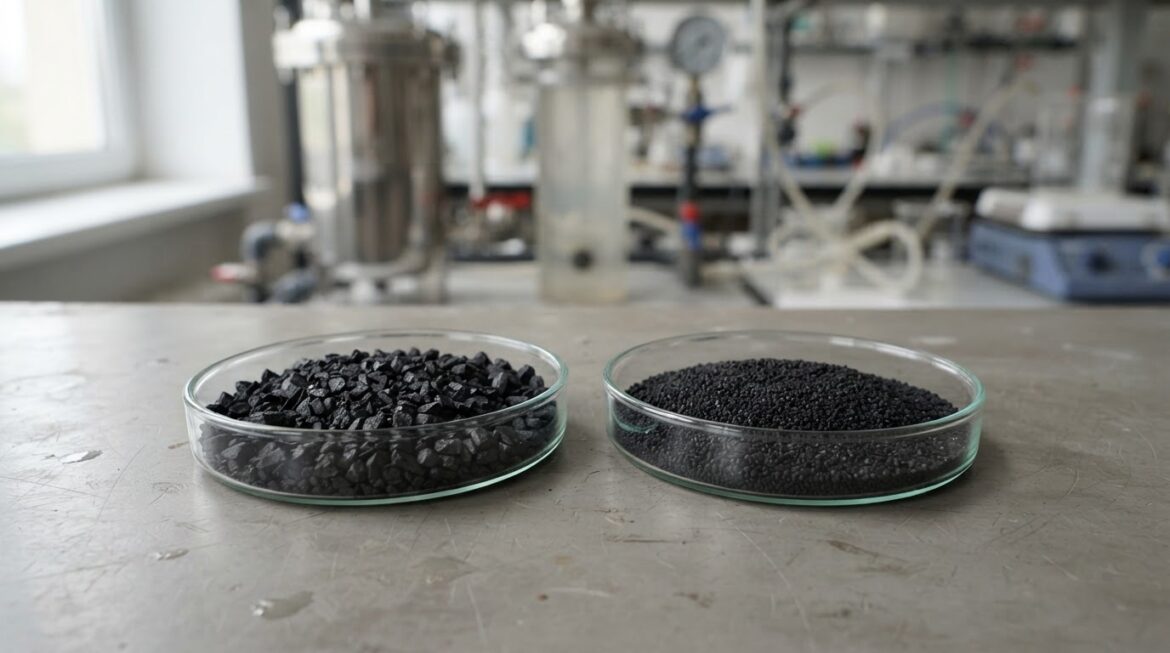
The short answer
Both conventional activated carbon and catalytic carbon can be useful in water treatment. Neither is automatically “best” for every home. The appropriate choice depends on the substances being targeted, incoming water chemistry, flow rate, media volume, contact time and the performance data available for the product.
What conventional activated carbon does
Activated carbon has a porous surface that can adsorb certain organic compounds and help improve taste and odor. It is commonly used to reduce free chlorine under suitable conditions. Its actual performance depends on the carbon product, bed depth, contact time and how much water has passed through it. Not every carbon media is certified for every contaminant.
What makes catalytic carbon different
Catalytic carbon is activated carbon that has been processed or selected to enhance certain surface-catalyzed reactions. Some catalytic-carbon products are used for chloramine reduction, which can be more demanding than free-chlorine reduction. The label “catalytic” alone is not a guarantee: verify the manufacturer’s performance claims, recommended operating conditions and applicable certifications.
Chlorine and chloramine are not interchangeable
Water utilities may use free chlorine or chloramine for disinfection. These are different residuals and should be tested appropriately. A system designed only around free-chlorine removal may not provide the desired chloramine reduction at household peak flow. Carbon filtration is a treatment process, not a substitute for knowing what is present in the supply.
Why contact time and flow rate matter
Water must spend enough time in contact with the media for the intended treatment. Increasing flow through the same bed reduces contact time. Tank size, media volume, plumbing diameter and valve selection all contribute to system performance. A hydraulic “maximum flow” number is not necessarily the flow at which a particular contaminant-reduction claim has been demonstrated.
What carbon does not do
Carbon filtration does not soften water: it does not remove calcium and magnesium hardness the way an ion-exchange softener does. It also should not be described as a universal solution for dissolved salts, nitrate, every PFAS compound or microbial hazards. Other treatment methods may be required depending on verified water-quality results and the treatment goal.
How to choose the right whole-house configuration
Start with a water-quality review and clarify the goal: taste and odor, disinfectant residual, sediment, hardness or a specific tested constituent. Next, assess peak flow, pressure drop, backwashing or replacement needs, available space and future maintenance. A design may combine whole-house catalytic carbon filtration with a separate water softener. The stages serve different purposes.
Frequently asked questions
Is catalytic carbon always better? No. Its advantages are application-specific.
Does catalytic carbon remove chloramine instantly? No. Performance depends on the media and adequate contact time.
Does carbon eliminate hardness scale? No. Carbon is not a water softener.
How long does carbon media last? There is no universal interval; loading, use and performance testing matter.
Ask about a customized design
Pro Filtration Water Systems evaluates the water-treatment objective and household demand before recommending equipment. For a tailored Orange County system, contact our team.
Leave a Reply