
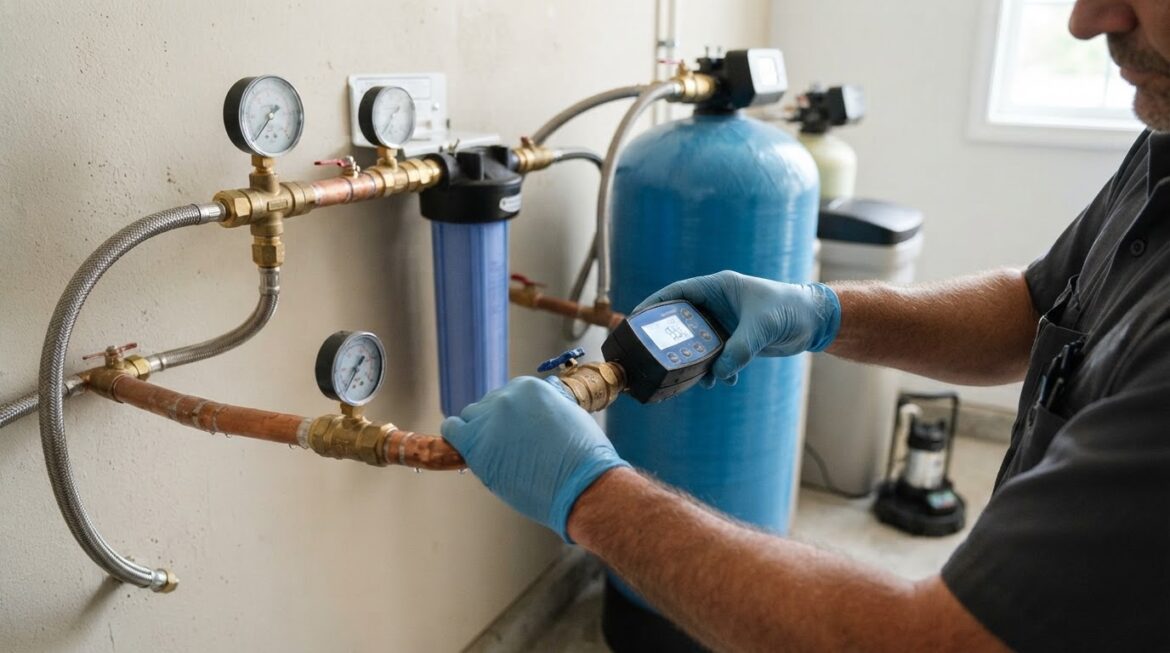
Why flow rate matters
A whole-house filter should treat water effectively without making normal household use frustrating. A system that looks large enough on paper may still restrict flow when multiple showers, faucets and appliances operate together. Good design starts with the home’s actual plumbing and water demand—not simply the number of bedrooms or the tank’s advertised capacity.
Flow rate is not the same as water pressure
Flow rate is the volume of water moving through a system, commonly measured in gallons per minute (GPM). Pressure is the force available to move that water, commonly measured in pounds per square inch (psi). A home can have good static pressure and still experience disappointing flow when several fixtures run. Every valve, fitting, cartridge and media bed introduces some resistance. The pressure drop across a filter increases as flow increases, so peak-use conditions matter.
How to estimate peak household demand
A designer reviews fixture count, likely simultaneous use, plumbing diameter, available pressure, and the household’s habits. Two showers and a washing machine running together may create a different design requirement than one shower at a time. Fixture ratings offer a starting point, but real measurements at the proposed installation location help validate the plan. A high advertised “maximum GPM” should not be mistaken for a guaranteed treatment flow rate.
Treatment contact time matters, too
For catalytic carbon, flow is more than a comfort issue. Water needs sufficient contact with the media for the treatment objective. Chlorine and chloramine removal are different challenges, and performance depends on media type, bed volume, contact time, inlet concentration and other water conditions. A system may pass water at a high hydraulic flow while offering less treatment performance at that same rate. Claims should be matched to appropriate test data and the specific application.
Tank size, valve size and plumbing work together
Tank dimensions and media volume influence contact time and hydraulic performance. The control valve, distributor, bypass and connection sizes also affect pressure loss. An undersized valve or restrictive installation can undermine an otherwise suitable media tank. Conversely, oversizing equipment without checking the site’s available pressure, drain arrangements and service requirements does not automatically produce a better result.
What about sediment filters?
Sediment cartridges protect downstream components when particulate removal is needed, but they also create pressure drop that changes as they load with debris. Cartridge size, micron rating, housing design and service interval should be selected for the application. A convenient bypass and pressure readings before and after the filter can make maintenance and troubleshooting easier.
How Pro Filtration approaches sizing
At Pro Filtration Water Systems, we assess the water-treatment goal, household usage, plumbing layout and available pressure before recommending a configuration. Depending on the water and objectives, a design may include whole-house filtration, a water softener, or separate stages with appropriate bypasses and service access. Testing and commissioning help establish a performance baseline.
Frequently asked questions
Will a larger tank always improve pressure? No. Valve sizing, piping, media characteristics and other restrictions all matter.
Can I size a filter from bathroom count alone? Bathroom count is a useful input, not a complete design.
Does a high maximum-flow rating guarantee chloramine removal? No. Hydraulic capacity and treatment performance are separate specifications.
Should I measure flow before installation? Where practical, yes—especially when several fixtures may run at once.
Get a system designed for your home
If you are planning a whole-house filtration system in Orange County, contact Pro Filtration to discuss water testing, fixture demand and a practical installation layout.
Leave a Reply