
Sediment Filtration Systems
Capture unwanted particles. Protect the treatment system that follows.
Sediment filtration helps remove suspended sand, silt, rust, and plumbing debris before those particles reach fixtures, appliances, and downstream water treatment equipment. The right pre-filter is selected for your water conditions and required flow—not simply by cartridge size.
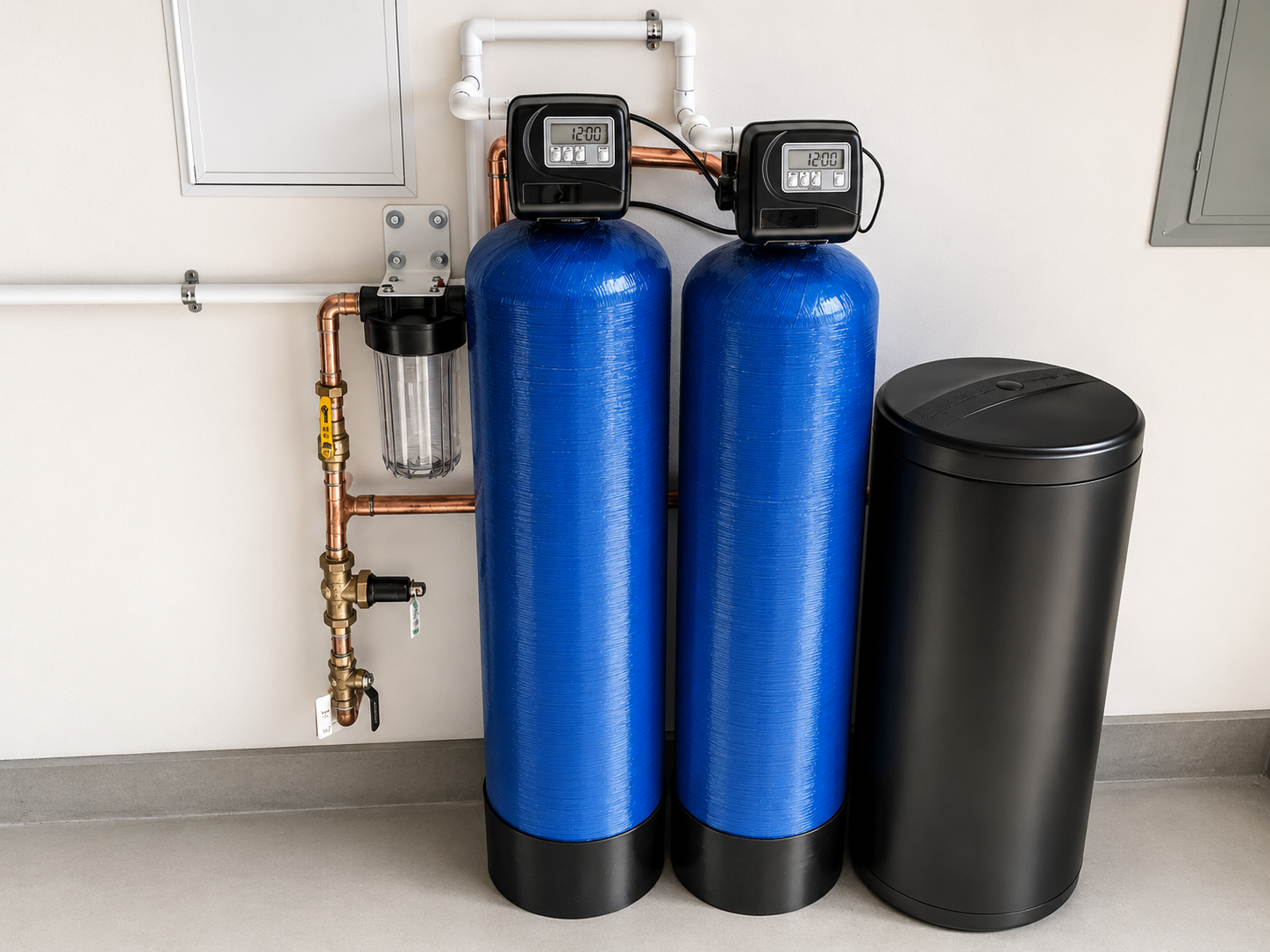
Physical particle removal—not dissolved-contaminant treatment. Sediment filtration targets suspended material. Carbon filtration, water softening, and reverse osmosis have different jobs within a complete water-treatment plan.
The first line of filtration
A sediment filter is often placed near the beginning of a treatment train, where it captures particles before they load up valves, carbon media, and point-of-use treatment components.
Incoming water
Sand, silt, iron particles, or plumbing debris may travel with the supply water. The type and amount of material determine the appropriate filtration approach.
Particle capture
A cartridge, screen, or backwashing filter captures particles within its designed range. Micron rating and filter construction affect what is retained.
Maintenance and flow
Collected solids increase resistance over time. Cartridge replacement, screen cleaning, or automatic backwashing restores performance according to the system design.
What sediment filtration targets
Sediment filtration is useful where visible or suspended particles create a service or equipment-protection problem. The actual contaminant and particle-size distribution should guide the design.
Sand and grit
Granular material from supply lines, some groundwater sources, and disturbed piping can cause abrasion and clog aerators, strainers, or equipment.
Rust and scale fragments
Loose corrosion products and mineral particles released from plumbing can be physically captured. Dissolved iron and hardness minerals require different treatment.
Silt and fine debris
Fine suspended material can cloud water or load downstream equipment. Choosing the correct filtration grade balances particle capture with pressure drop.
Important: A sediment filter is not a disinfectant-removal system and does not reliably remove dissolved salts, hardness, PFAS, or microorganisms. Those needs require separate evaluation and appropriately selected technologies.
Choosing the right sediment filter
There is no universally best cartridge. The best choice depends on what the water carries, how much water the property uses, and how the equipment will be serviced.
Cartridge filtration
Replaceable cartridges in appropriately rated housings are a practical choice for many residential pre-filtration applications. Common options include pleated, spun, and depth-gradient designs.
Spin-down or screen
Cleanable screen filters can be useful for larger grit and heavier particles. Their particle-removal range differs from fine cartridge filtration.
Backwashing filtration
For sustained sediment loading or higher flows, properly engineered backwashing systems may reduce the frequency of manual cartridge changes.
Small component. Important design decisions.
Pro Filtration evaluates sediment filtration as part of a complete plumbing and water-treatment system. Oversized pressure losses, undersized housings, and unsuitable cartridges can create problems even when the water appears clear.
How the treatment stages fit together
Illustrative only. Actual treatment order, bypasses, pipe sizes, cartridge grade, and system components depend on water analysis and site conditions.
Sediment filtration FAQs
Direct answers to common questions about sediment filters, micron ratings, maintenance, and how they fit into a whole-house system.
What does a sediment water filter remove?
It captures suspended particles such as sand, silt, rust, and debris within the filter’s rated range. It is not designed to remove dissolved hardness minerals, chlorine, chloramine, or salts.
Is a 5-micron sediment filter good for a whole house?
A 5-micron cartridge is a common starting point, but suitability depends on particle size, filter construction, sediment loading, peak flow, and acceptable pressure drop. A nominal micron rating is not the same as an absolute rating.
Does sediment filtration remove chlorine or chloramine?
No, ordinary mechanical sediment filters do not meaningfully remove dissolved chlorine or chloramine. Carbon filtration is typically used for disinfectant reduction, with media selected for the specific water supply.
Should a sediment filter go before a water softener?
Often, yes. Pre-filtration can help protect downstream treatment components from suspended solids. The proper arrangement depends on the supply, equipment specifications, and the full treatment design.
How often should a sediment filter cartridge be replaced?
There is no fixed interval for every property. Replacement depends on incoming sediment, cartridge capacity, water use, pressure differential, and manufacturer guidance. A noticeable pressure drop may indicate a loaded cartridge.
What is the advantage of a clear filter housing?
A transparent housing makes it easier to observe visible cartridge discoloration and sediment accumulation. It cannot verify water quality by itself, and the housing must be suitable for the installation conditions.
Let’s design around your water.
We select equipment around water quality, plumbing layout, household or facility demand, and long-term service requirements—not a one-size-fits-all filter package.